

Heart Rate
The Heart Rate (HR) measures the number of times the heart beats per minute. It is a useful metric for monitoring user fitness level and overall health. Generally, a lower heart rate at rest implies more efficient heart function and better cardiovascular fitness. For example, a well-trained athlete might have a normal resting heart rate closer to 40 beats per minute.
How is it calculated?
Section titled “How is it calculated?”After systolic peak detection of the PPG signal, heart rate is calculated by counting the systolic peaks per minute in this pulse signal.
Accuracy
Section titled “Accuracy”Comparative analyses between heart rate sensors and IntelliProve revealed a mean absolute error of 2.10 ± 2.36 beats per minute for heart rate estimation through IntelliProve. In 92% of the measurements the absolute measurement error is less than 5 beats per minute. A correlation of r=0.982 (p<0,00001) is observed between the two measurement methods.
How can it be used?
Section titled “How can it be used?”The resting heart rate can be used as a first indicator of the body’s health state and mental health state. When a person experiences stress, the body’s sympathetic nervous system is activated, leading to an increase in heart rate frequency. This is part of the body’s natural response to preparing for action. When we experience stress due to high workload, the body will react equally.
Chronic or prolonged stress can lead to sustained elevation of resting heart rate. If you frequently experience stress or have a high-stress lifestyle, your resting heart rate may be higher than average, even during periods of rest.
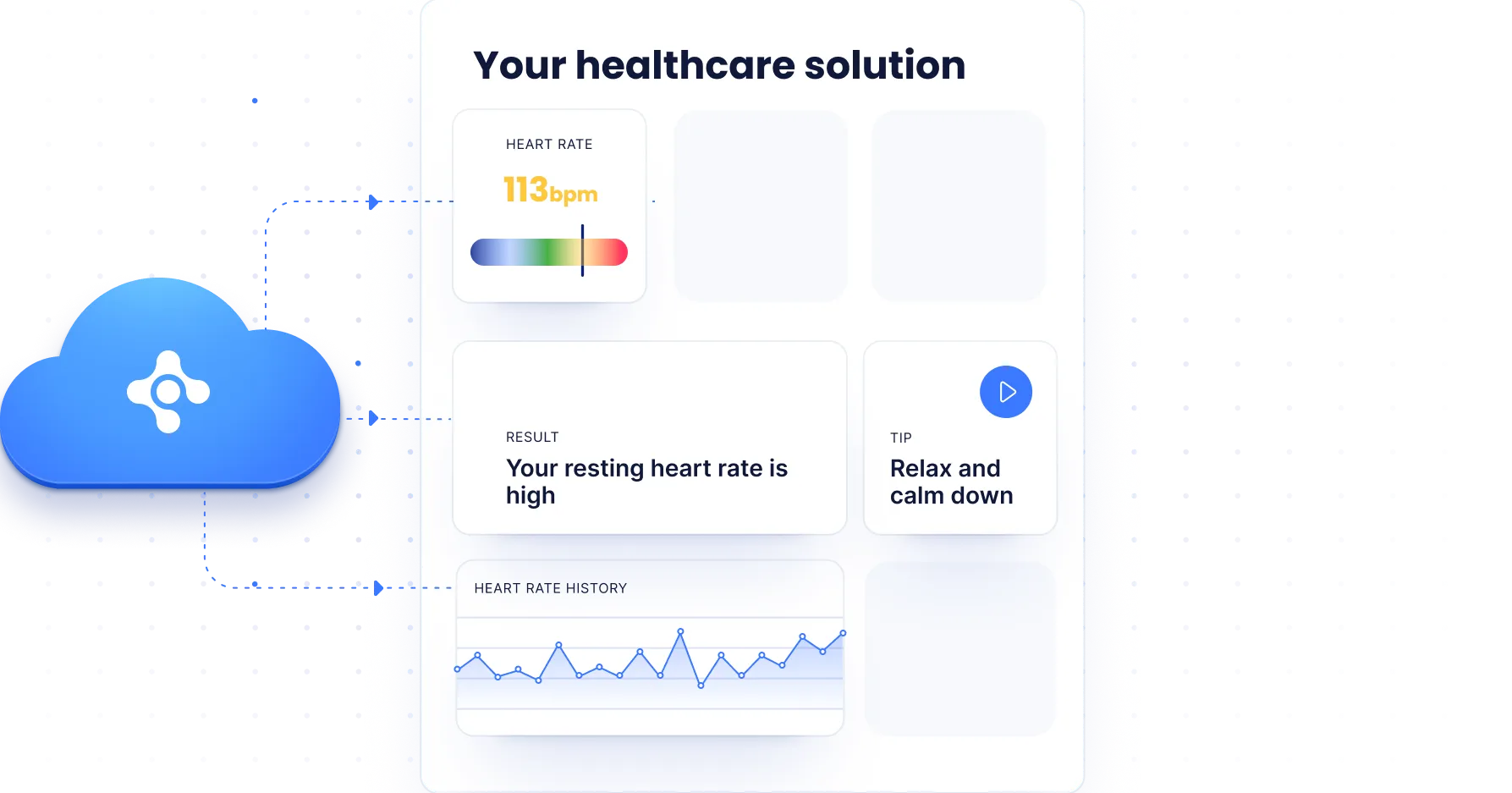
With IntelliProve, the resting heart rate can be measured and compared to the population and/or user baseline. Based on the interpretation table below, personalised recommendations can be made to bring the resting heart rate to an acceptable level. For example, multiple meditation and relaxation exercises would help the user to calm down.
Interpreting results
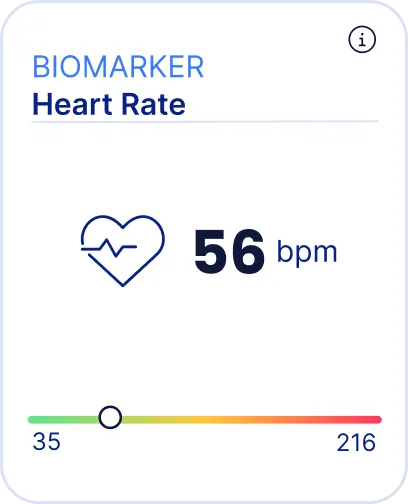
Section titled “Interpreting results”Heart Rate is returned as an integer on a scale of 36 – 216 and can be requested as a Widget or via the Rest API.
Definitions
Section titled “Definitions”| Name | Unit | Range | programmatic name | Health Profile |
|---|---|---|---|---|
| Heart Rate | Beats per minute [bpm] | 36-216 | heart_rate | Physical Health |
Values
Section titled “Values”Value | Meaning | Zone | Example User Text |
36 - 56 | Very low | Green | Your heart rate at rest is very low. In general, a resting heart rate for an adult is between 60 and 100 beats per minute. |
57 - 63 | Low | Green | Your heart rate at rest is low. In general, a resting heart rate for an adult is between 60 and 100 beats per minute. |
64 – 71 | Below average | Green | Your heart rate at rest is lower than the average heart rate. In general, a resting heart rate for an adult is between 60 and 100 beats per minute. |
72 – 85 | Average | Green | Your heart rate at rest is average. In general, a resting heart rate for an adult is between 60 and 100 beats per minute. |
86 – 100 | Above average | Yellow | Your heart rate at rest is higher than the average heart rate. In general, a resting heart rate for an adult is between 60 and 100 beats per minute. |
101 - 216 | High | Red | Your heart rate at rest is high. In general, a resting heart rate for an adult is between 60 and 100 beats per minute. |
Scientific papers
Section titled “Scientific papers”- Verkruysse W, Svaasand LO, Nelson JS. 2008. Remote plethysmographic imaging using ambient light. Opt Express. 16(26):21434–21445.
- Addison PS, Jacquel D, Foo DMH, Borg UR. Video-based heart rate monitoring across a range of skin pigmentations during an acute hypoxic challenge. J Clin Monit Comput. 2018 Oct;32(5):871-880.
- Poh MZ, McDuff DJ, Picard RW. 2010. Non-contact, automated cardiac pulse measurements using video imaging and blind source separation. Opt Express. 18(10):10762–10774.
- Shirbani F, Hui N, Tan I, Butlin M, Avolio AP. Effect of Ambient Lighting and Skin Tone on Estimation of Heart Rate and Pulse Transit Time from Video Plethysmography. Annu Int Conf IEEE Eng Med Biol Soc. 2020 Jul;2020:2642-2645.
- Sun Y, Thakor N. 2016. Photoplethysmography revisited: from contact to noncontact, from point to imaging. IEEE Trans Biomed Eng. 63(3):463–477.